Turning contacts into business opportunities through AI-driven workflows
Turning fragmented networking interactions into structured, actionable next steps

Team: Jr. Designer, 3 Developers, Marketing Team
Problem
Networking creates connections—but not outcomes
Service-based professionals spend 5–10 hours per week networking—meeting people, building relationships, and expanding their reach.
But after the interaction:
-
Contacts are scattered across tools
-
Conversations are hard to track
-
Follow-ups are delayed or forgotten
-
Opportunities are missed
Result: Users don’t know who to follow up with and when
Outcomes
60%
Reduction in follow-up time
2x
Increase in initial conversations
85%
Users reported significant workflow improvement
Understanding User Needs
Understanding Multiple Stakeholders
Conducted stakeholder interviews, user interviews, and analysis of existing tools and interaction logs to uncover workflow gaps and behavioral patterns across how teams manage contacts and follow-ups.
Sales Professional / Business Owner
-
Actively networking and meeting new people
-
Relies on memory or scattered tools
-
Struggles to prioritize follow-ups
-
Misses high-value opportunities
Admin / Team
-
Manages communication, quotations, and coordination
-
Works remotely across multiple contacts
-
Lacks visibility into conversations
Customer / Lead
-
Expects timely responses
-
Loses interest when communication is delayed
-
Experiences inconsistent follow-up
Understanding the Real-World Journey
Spent time in the field to understand what actually happens after networking interactions and identify clear behavioral patterns
-
Attended trade shows, meetups, and workshops
-
Observed how business owners captured and managed contacts
-
Spoke directly with professionals after interactions

Key Insights
What the research told us
Follow-up speed impacts conversion
Contacts followed up within 24 hours are 3× more likely to convert than those reached after a week.
Fragmentation reduces consistency
Switching between 4+ tools causes dropped follow-ups and inconsistent messaging across touchpoints.
Users need guidance, not just data
Raw data overwhelms; actionable recommendations drive user confidence and faster decision-making.
Design Challenge
How might we help users identify and act on the right opportunities within their network—without adding complexity to their workflow?
Product Decisions
Key trade-offs & final calls
Visibility vs. Organization
We chose to surface relevant contacts proactively instead of building a rigid folder structure. Opportunities should find the user.
→ Opportunity visibility
Manual Effort vs. AI Assistance
Rather than automating everything, we designed an AI layer that suggests — not decides. Users stay in control while reducing cognitive load.
→ AI-assisted guidance
Data vs. Action
Instead of dashboards filled with metrics, we focused on actionable insights — what to do next, not what happened yesterday.
→ Action-first design
System Workflow
From lead to conversion

Solution
Unifying fragmented tools into a single workflow
To address fragmented tools, disconnected workflows, and missed opportunities, the product was designed as a unified system that transforms interactions into actionable insights; guiding users on who to follow up with, when to act, and how to move relationships forward.

Designing the intelligence layer (AI-assisted guidance)
To support decision-making, a data-driven layer was introduced to analyze interaction patterns and surface relevant opportunities.

Designing the experience layer
We have implemented all the findings and insights from multiple research studies and interactions with users. Through a series of brainstorming sessions, we were able to ideate and develop innovative solutions that address the needs and preferences of our target audience.
By leveraging user feedback and data-driven research, we have crafted strategies that enhance user experience, improve functionality, and foster meaningful connections. Our collaborative approach ensured that every aspect of our product was meticulously designed to meet the highest standards of quality and performance.


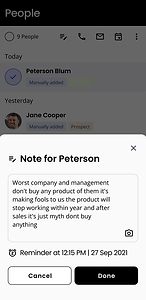
Initially, these action buttons were on the contact page. We moved them to the contact details page. This change allowed users to access all actions and logs intuitively right after clicking on a contact, significantly improving the user experience.
Initially, these action buttons were on the contact page. We moved them to the contact details page. This change allowed users to access all actions and logs intuitively right after clicking on a contact, significantly improving the user experience.


Impact
Business outcomes
60%
Reduction in follow-up time
Reduced average response time from days to hours
2x
More conversations
Doubled initial outreach conversations rate
85%
Productivity gain
Users reported significant workflow improvement
Constraints
Working within real-world limit
Small team
3 cross-functional members wearing multiple hats
Limited resources
Bootstrapped environment with tight engineering bandwidth
Fast iteration
2-week sprints with rapid user testing and pivots
Reflection
Clarity over complexity
Every feature we removed made the product stronger. The hardest work was deciding what not to build.
Action over data
Users don't need more dashboards — they need to know what to do next. We designed for momentum.
Balancing automation and personalization
The best systems amplify human judgment, not replace it. Semi-automated workflows preserved authenticity while saving hours each week.